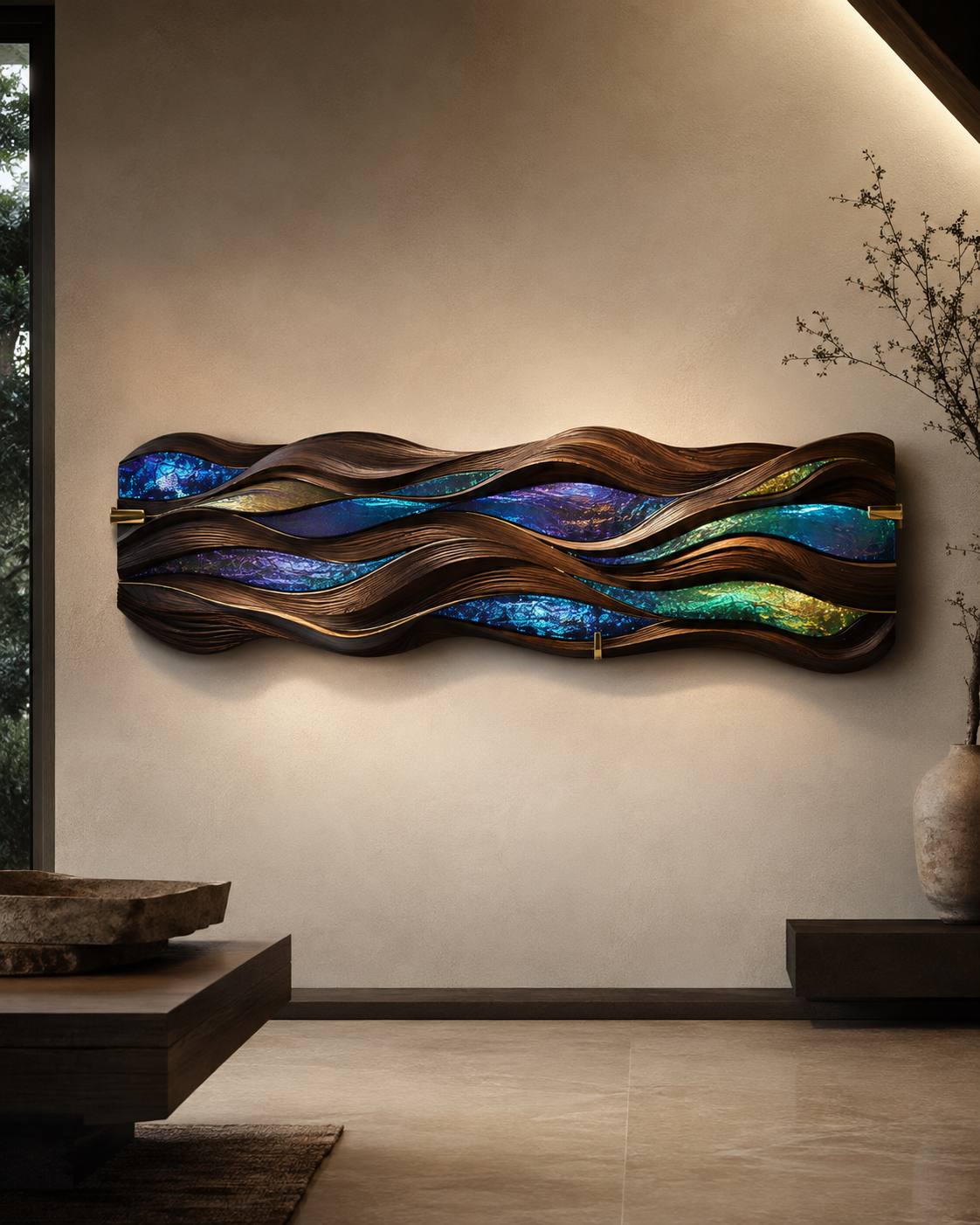
Wall art that changes color as you walk past it
Monsoon / Aurora
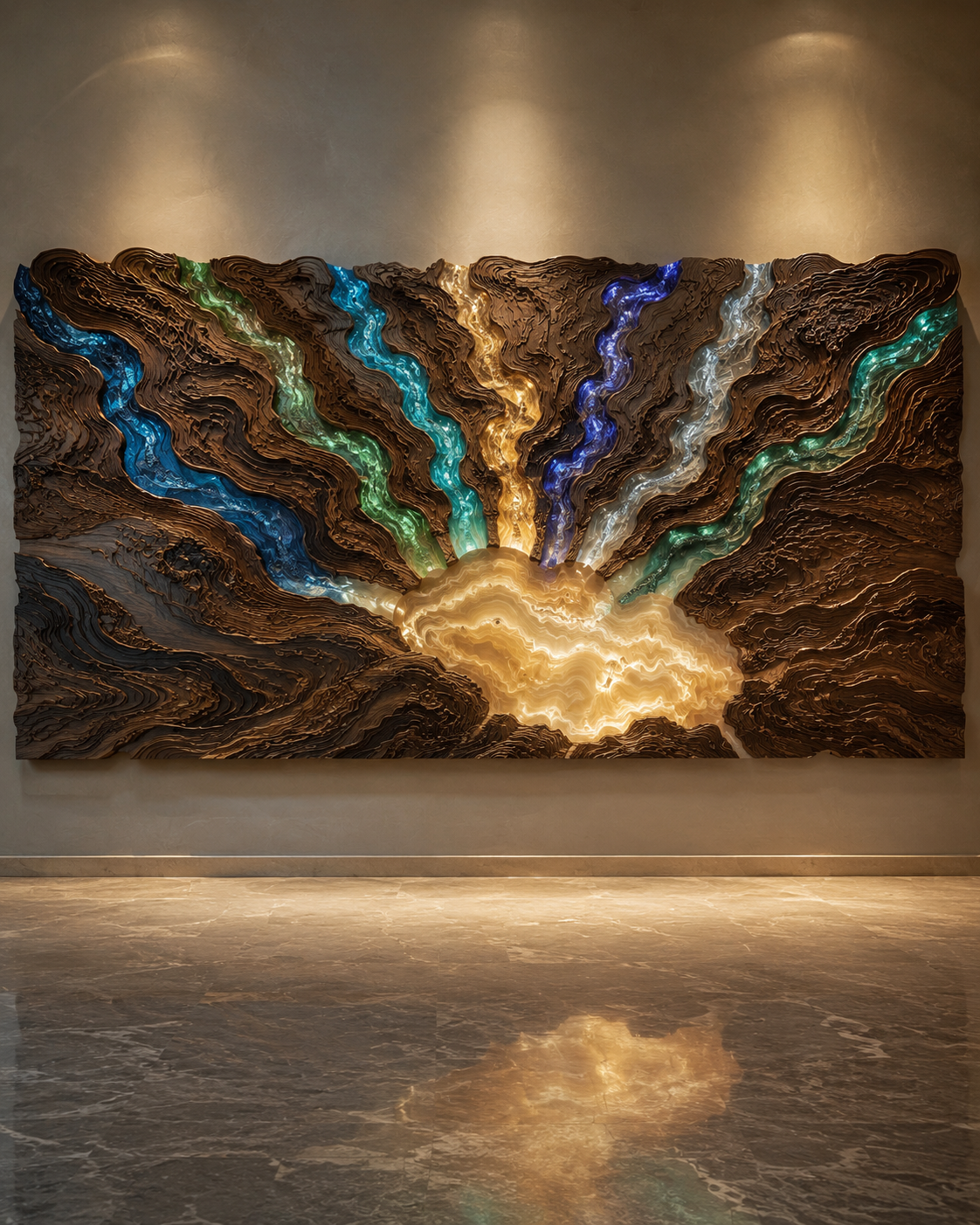
Dark carved wood waves that suddenly show blue, purple, green and gold color as you move and look at it from different angles.
Moving & Light-Up Wall Art
Monsoon / Aurora — carved wood waves and glass that changes color as you move
Walk past this piece and it changes color under you — deep blue from one spot, then purple, green, a flash of gold from another. There are no screens and no electronics doing it. The color shift is built into the glass itself. Monsoon / Aurora pairs carved dark-wood waves with special color-shifting (dichroic) glass, so the piece behaves differently depending on where you stand and how the light falls.
The science here is genuinely space-age. Dichroic glass carries ultra-thin layers of metal oxides, and the color you see comes from thin-film interference — certain wavelengths of light get reflected while others pass through, so the color changes with the viewing angle [Dichroic Glass, Skyjems]. The technology was developed for aerospace: as NASA's own Spinoff publication puts it, "NASA revitalized the production of dichroic glass in the 1950s and 1960s as a means of protecting its astronauts" and their instruments from unfiltered sunlight and radiation [Ultra-Thin Coatings Beautify Art, NASA Spinoff]. It later crossed over to art through people who had worked on the aerospace side — My Modern Met credits former aerospace engineer Murry Schwartz, who worked in the 1960s for NASA contractor Wallin Optical Systems, as a pioneer of dichroic glass as an art material. So the shimmer on your wall runs on the same optical trick that shields astronaut visors.
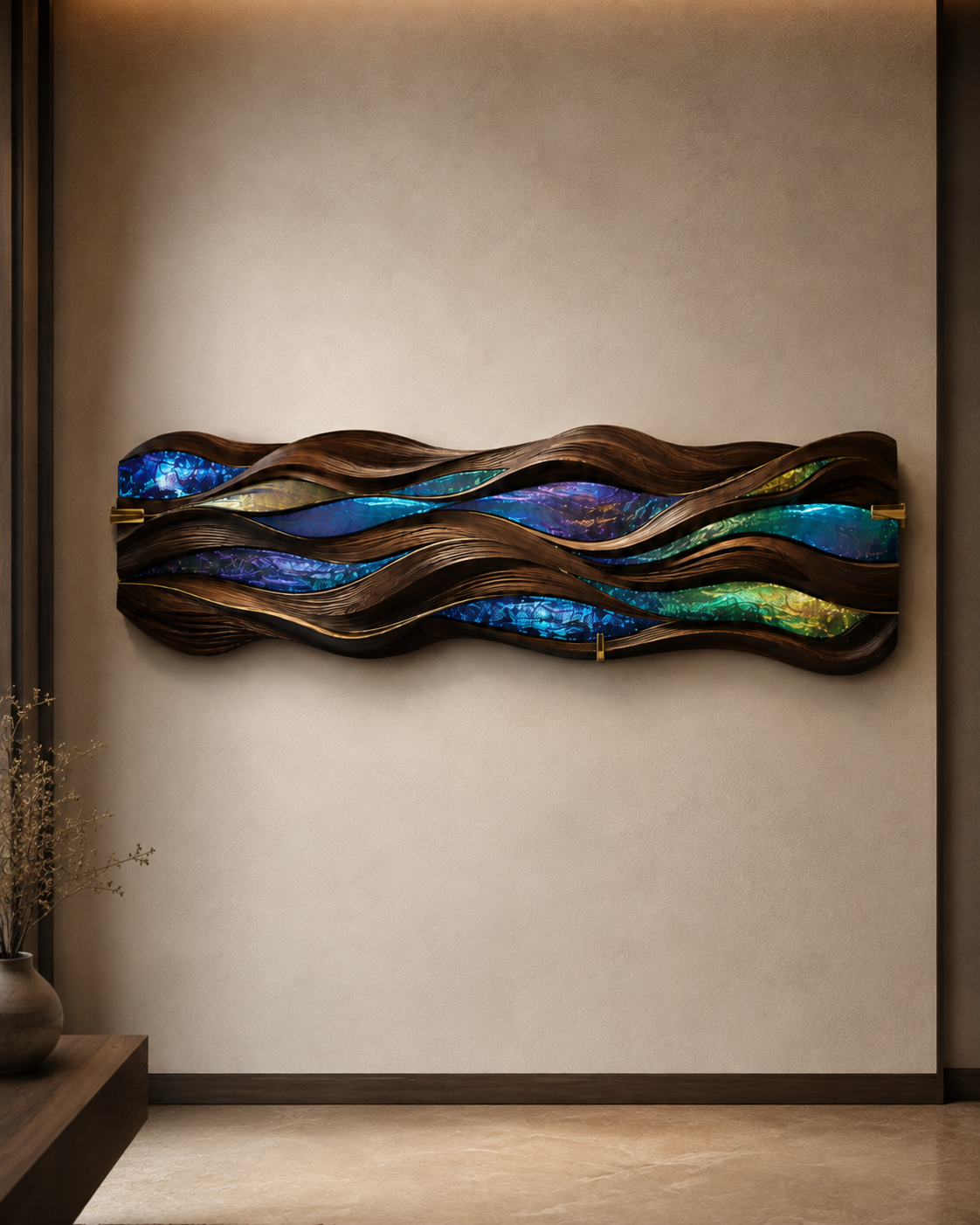
The name joins two natural light shows. One is the aurora — the northern lights. Those colors are made when charged particles from the sun hit gases high in Earth's atmosphere: oxygen glows green (at a wavelength of 557.7 nm) and red, while nitrogen adds blue, purple and pink [The Colors of the Aurora, US National Park Service]. Green is the most common; the rarer reds and purples show up during strong solar activity [Aurora colors, Space.com]. The other half of the name is the Indian monsoon — the southwest rains that arrive first in Kerala around the start of June and, according to the India Meteorological Department, supply "about 75 per cent of India's annual rainfall," the water the whole country's harvest depends on [WION, citing IMD]. The monsoon has its own colors in Indian culture: the raga family Malhar is "inextricably linked to the rejuvenating effects of rain," and Miyan ki Malhar was said to be sung to summon the monsoon itself [Ragajunglism]. The carved waves are the rain and the sea; the glass is the aurora and the changing sky.
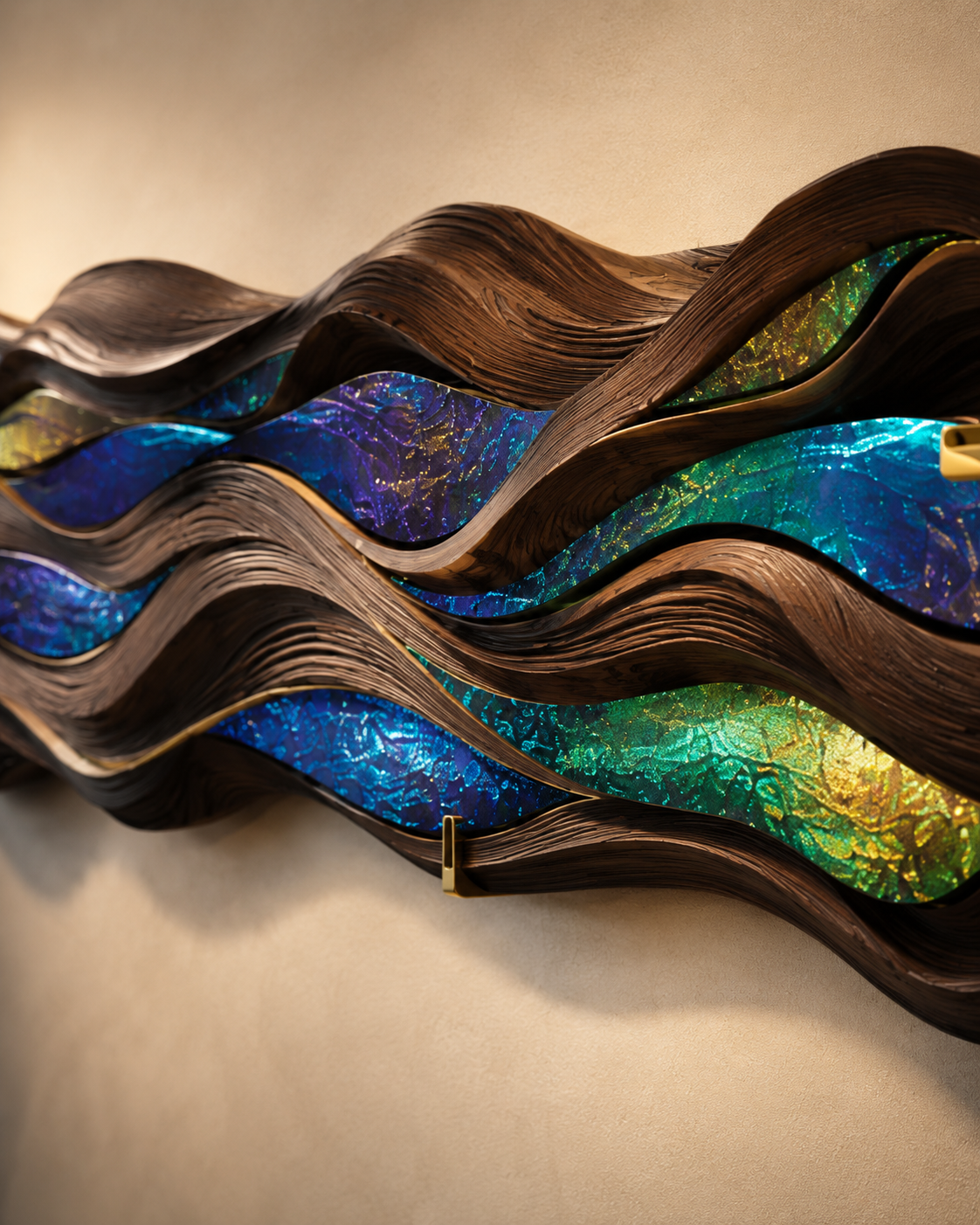
How it works
- Carved teak or walnut waves form the solid, dark base.
- Dichroic (color-changing) glass shifts through blue, purple, green and gold depending on your angle and the light — no power, no screens.
- The effect is entirely natural to the glass, so it never dates or breaks down like a device.
Why commission this one, and who it’s for
This is for a room with changing daylight and people moving through it — an entryway, a stairwell landing, a living room with big windows. A framed print is dead on arrival; this one is different every time you cross the room, and it never repeats. It suits collectors who want something that feels alive without a single wire showing.
Materials & craft
Carved teak or walnut waves combined with dichroic (thin-film) glass. The color shift is a property of the glass, not lighting.
Enquire
Tell us the wood tone and the color range you're drawn to — cool blues and greens, or warmer gold and violet — and where the daylight comes from in your room.
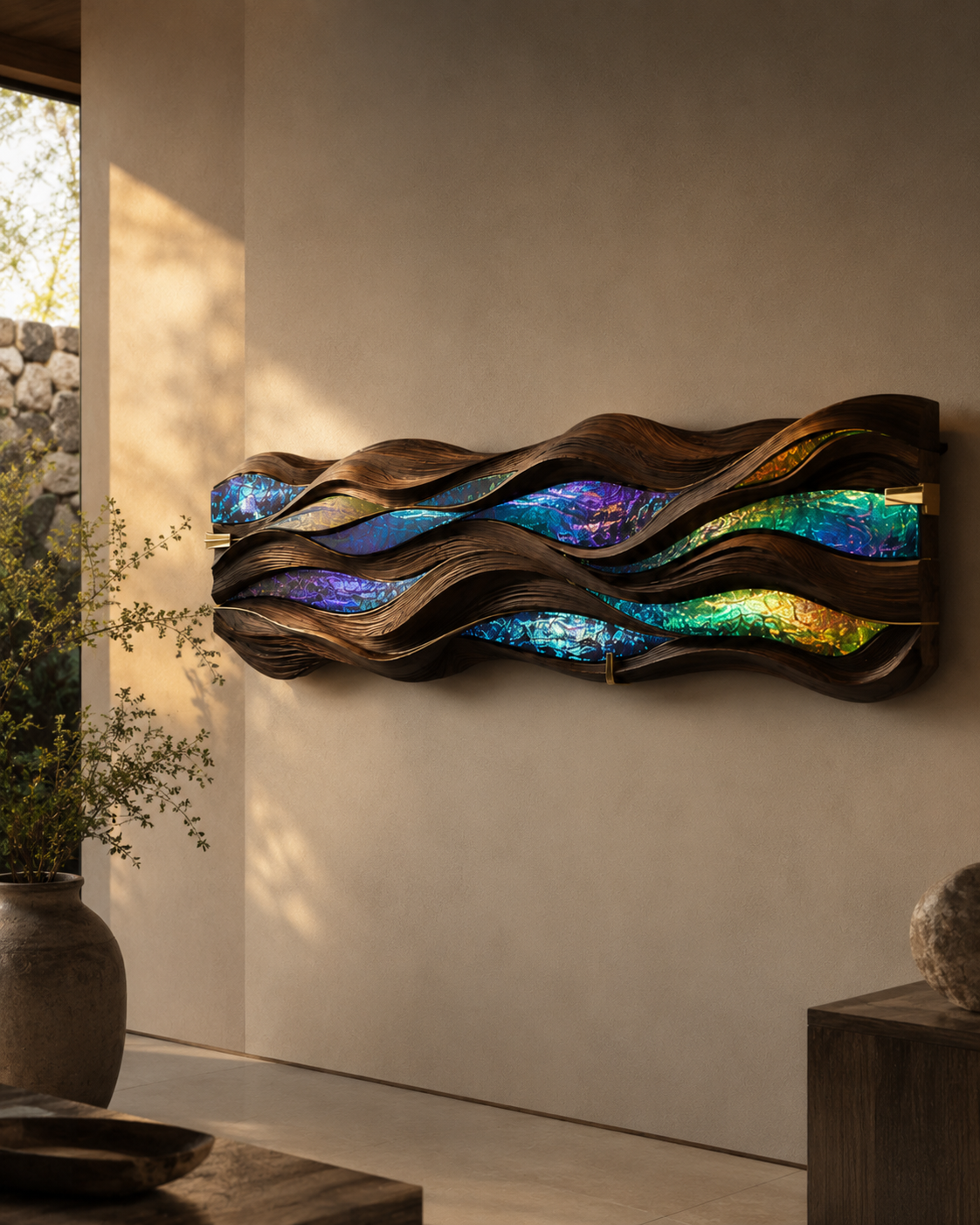
In a room
Monsoon / Aurora in a daylit living room
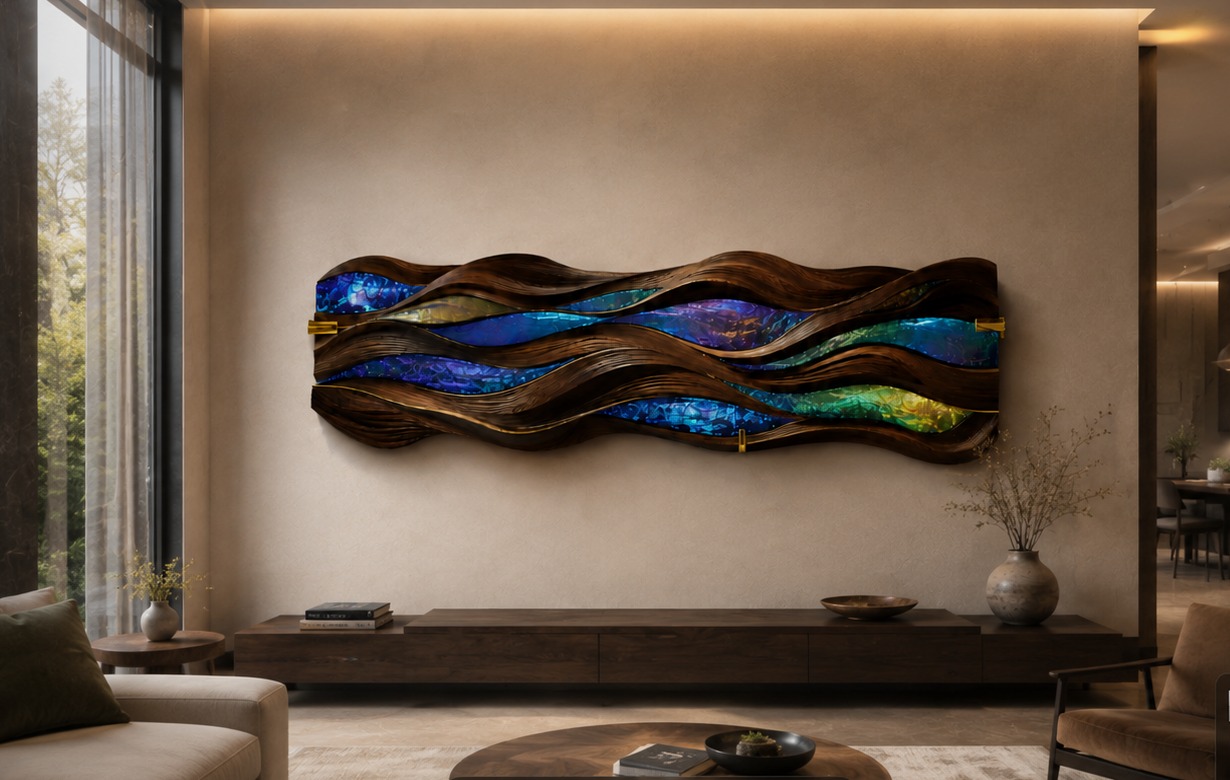
Illustrative visualisation at catalogue scale. Interiors, lighting and styling are shown to help read size and depth — not an installation template for your own wall.
Specification
- Dimensions
- 260 W × 110 H × 18 D cm≈ 102 × 43 × 7 in
- Reference
- STH-MA-004
- Primary materials
- Carved teak or walnut wood; color-changing glass
- Secondary materials
- Brass edge details; concealed mounting frame; optional low-voltage lighting
- Finish
- Deep hand-rubbed wood finish with polished colour-shifting glass
- Made to order
- Yes
- Customisation
- Wave shape, wood type, glass color choice, lighting, direction and overall size
- Recommended placement
- Luxury living rooms, hotel lounges, private corridors and collector residences
- Installation
- Professional structural mounting; lighting and sightline testing recommended
- Shipping
- Museum-grade custom crate with specialist glass handling; installation quoted separately
- Care
- Dry dust carved wood; clean glass with a non-abrasive microfibre cloth and approved cleaner
Commission enquiry
This is a made-to-order commission. Price depends on scale, materials, finish and site engineering, and is quoted after a wall survey — there is no fixed list price and no checkout.
Sources
- Dichroic Glass (thin-film interference) — Skyjems — https://skyjems.ca/pages/encyclopedia-dichroic-glass
- Ultra-Thin Coatings Beautify Art (NASA origin) — NASA Spinoff — https://spinoff.nasa.gov/Spinoff2012/cg_2.html
- The Colors of the Aurora — US National Park Service — https://www.nps.gov/articles/-articles-aps-v8-i1-c9.htm
- Aurora colors: what causes them — Space.com — https://www.space.com/aurora-colors-explained
- Miyan ki Malhar (raga and rain) — Ragajunglism — https://ragajunglism.org/ragas/miyan-ki-malhar/