Sound & Custom Wall Art
The Silence Engine
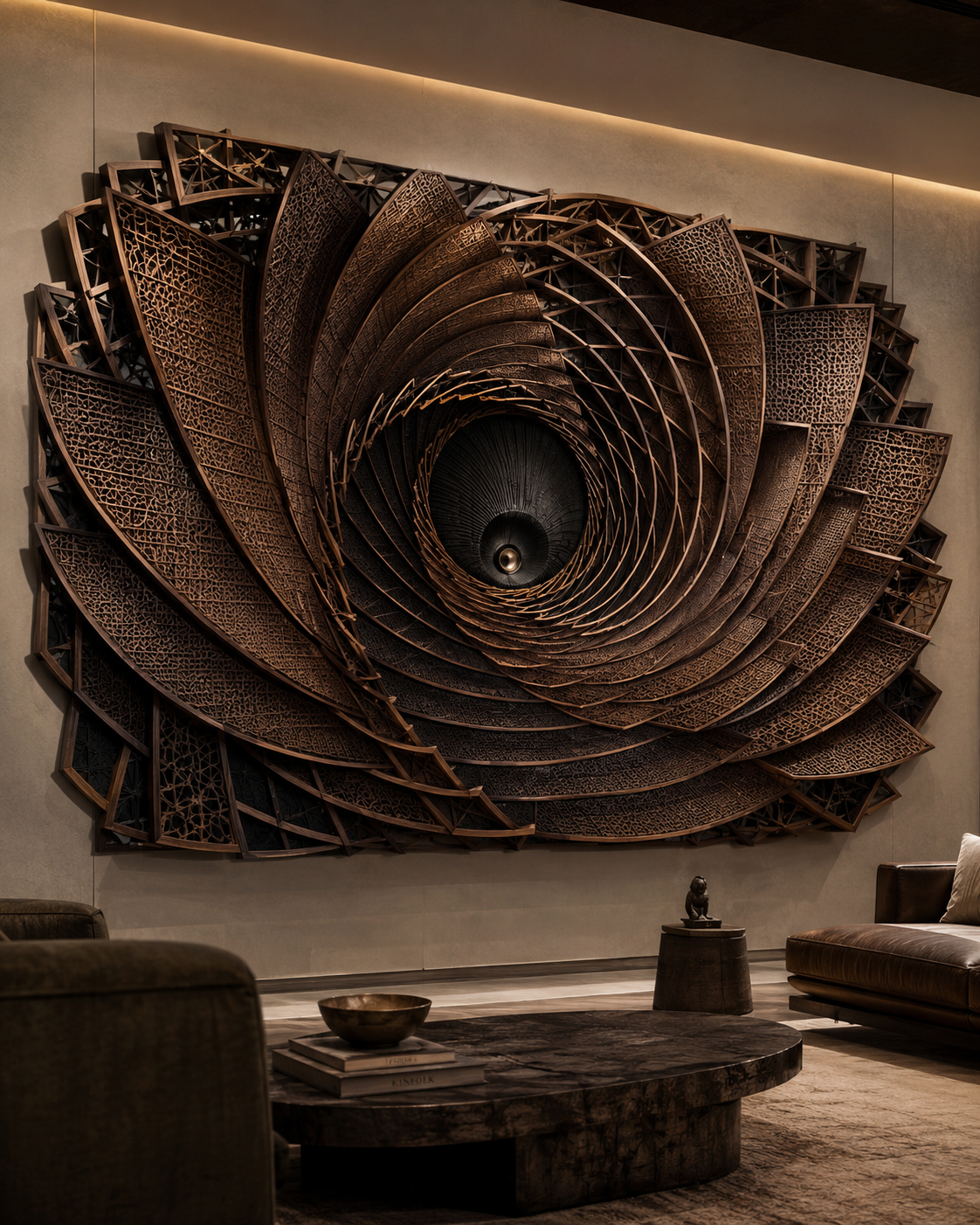
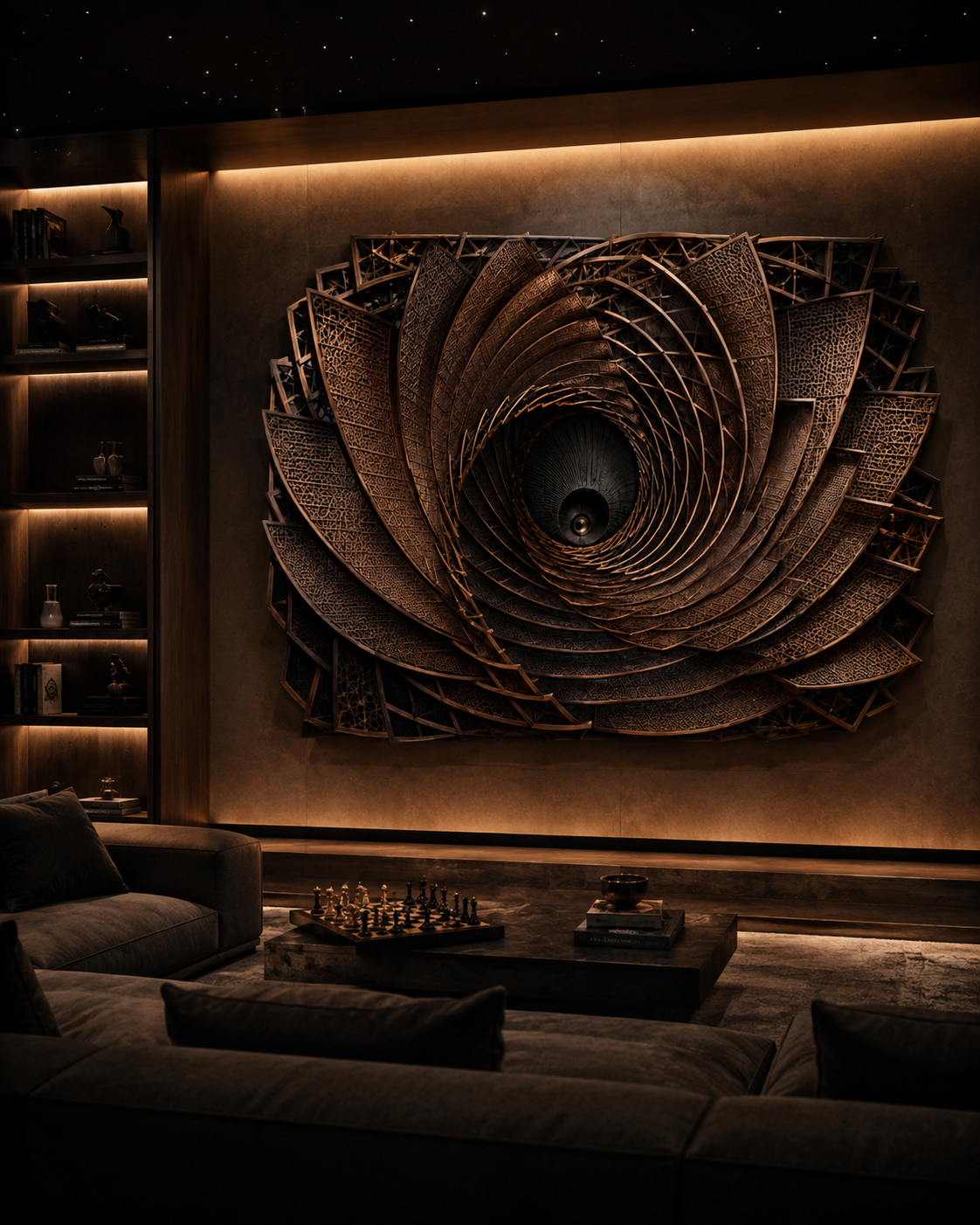
A giant carved wood wall sculpture shaped like a swirling pattern, with hidden sound-absorbing material built in so it also makes the room quieter.
Hundreds of carved wood fins swirl together into one giant wall pattern.
Sound & Custom Wall Art
The Silence Engine — a ten-foot wall of carved wood that also makes your room sound better
You know the feeling of a room that's too loud on the inside. TV dialogue gets muddy, music turns harsh, and everyone ends up raising their voice. The Silence Engine is a large carved-wood wall sculpture — roughly ten feet (about 320cm) across — built from hundreds of deeply carved wooden fins that swirl out from a center like a slow whirlpool. Behind that carving sits real sound-absorbing material, hidden from view. So the piece does two jobs at once: it's the thing everyone looks at, and it's quietly fixing how the room sounds.
The pattern comes from two old traditions that never met until now. The first is the Indian jali — a carved lattice screen. The word comes from a term meaning "net," and jalis are perforated stone or wood screens cut in geometric or plant-based patterns, common in Indian and Indo-Islamic architecture [Jali, Wikipedia]. They weren't just decoration. A jali cuts glare and heat while still letting light and air through, and because the openings are small, even a mild breeze speeds up as it passes through — the architect Yatin Pandya notes the jali "manages to cut down on direct sun and thereby the heat ingress" while allowing cross-breeze [History of Jalis in Indian Architecture, Penn State]. In Mughal palaces the finest jalis were carved in marble, like the screens inside the Taj Mahal [Jali in Mughal Architecture, DailyArt Magazine].
The second tradition is Japanese kumiko — the craft of fitting thin wooden pieces together in geometric patterns without a single nail, screw, or drop of glue. It was developed in Japan in the Asuka Era (roughly 600–700 AD) [Kumiko, Japan Woodcraft Association]. The work is astonishingly fine: the maker Tanihata notes that "assembling pieces with an accuracy of 0.1mm is performed with special care," and the pressure of the joints alone holds everything in place [Kumiko (woodworking), Wikipedia].
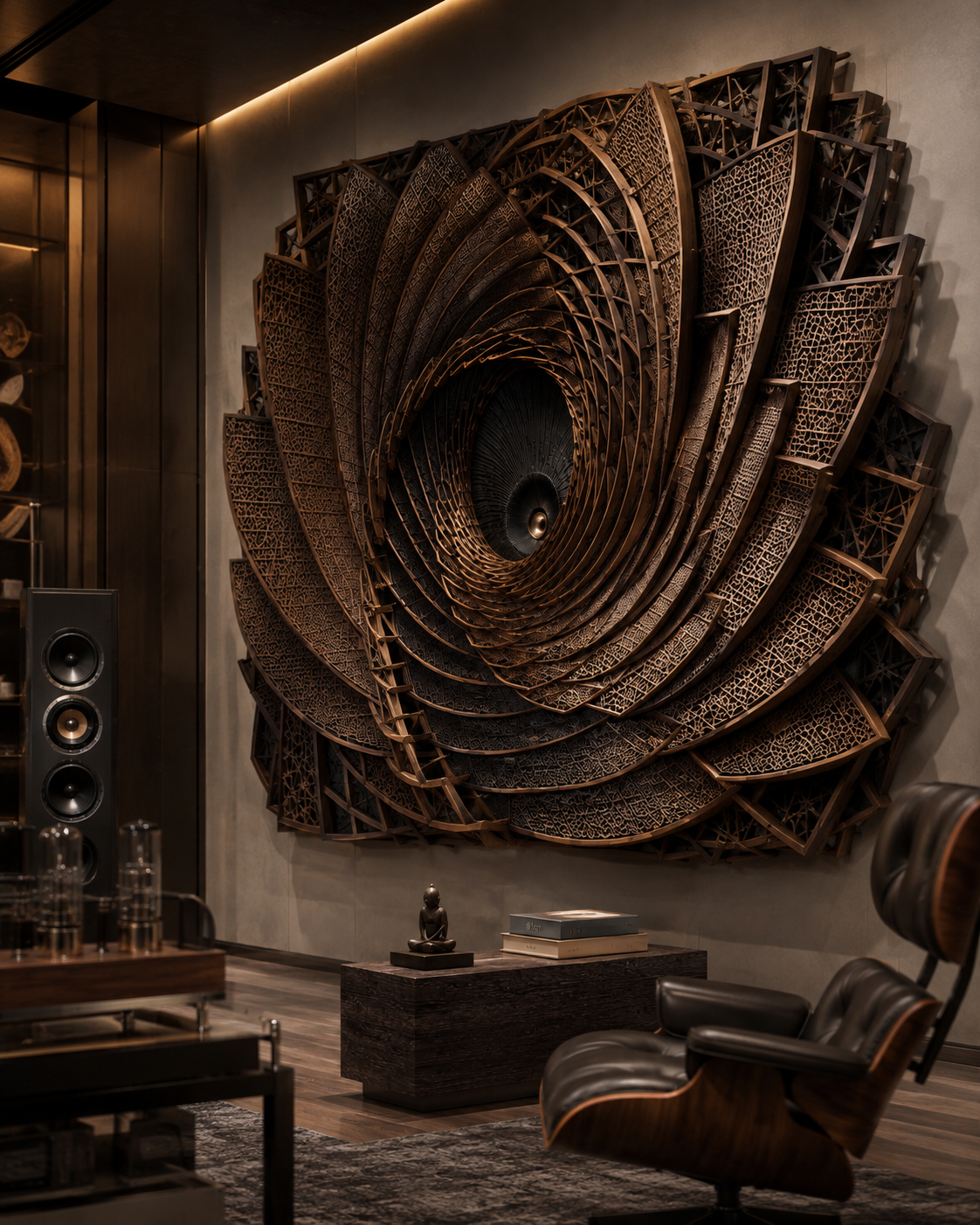
Here's where the modern science comes in. In room acoustics there are only three things a surface can do to sound: absorb it, reflect it, or diffuse (scatter) it [US Patent 9,508,334, USPTO]. A flat wall bounces sound straight back, so all the reflections hit your ear at once — that's what makes a room feel harsh or echoey. A diffuser, with its uneven carved surface, scatters those reflections in many directions so they arrive at different times, which calms the room without deadening it [Understanding Diffusion, GIK Acoustics]. Absorption, meanwhile, soaks up sound energy using soft, porous material and is best at higher frequencies [Absorption vs. Diffusion, Illuminated Integration]. The Silence Engine uses both: the deep carved fins scatter sound the way a diffuser does, and the hidden material behind them absorbs it. That combination — scatter plus soak — is exactly how good listening rooms are treated.
What it does
- Acts as a genuine acoustic treatment for a home theater, music room, or big living room — scattering and absorbing sound so speech is clearer and music is less harsh.
- Works as a single dramatic focal point on a large wall, roughly 10 feet across.
- Made from carved teak or walnut, with the sound-absorbing layer built in behind the carving so you never see it.
Why commission this one, and who it’s for
If you've spent real money on speakers or a projector and the room still sounds "off," this solves the actual problem — most decorative art ignores acoustics, and most acoustic panels look like office ceiling tiles. This is the rare object that does both honestly. It's for people building a serious media room or music space who refuse to hang foam squares on the wall.
Materials & craft
Carved teak or walnut, hundreds of individually shaped fins arranged in a vortex, with a concealed sound-absorbing layer. Scale is roughly 10 feet / 320cm across.
Enquire
Every Silence Engine is carved to the wall and room it will live in. Tell us about your space and we'll design the piece around it.
In a room
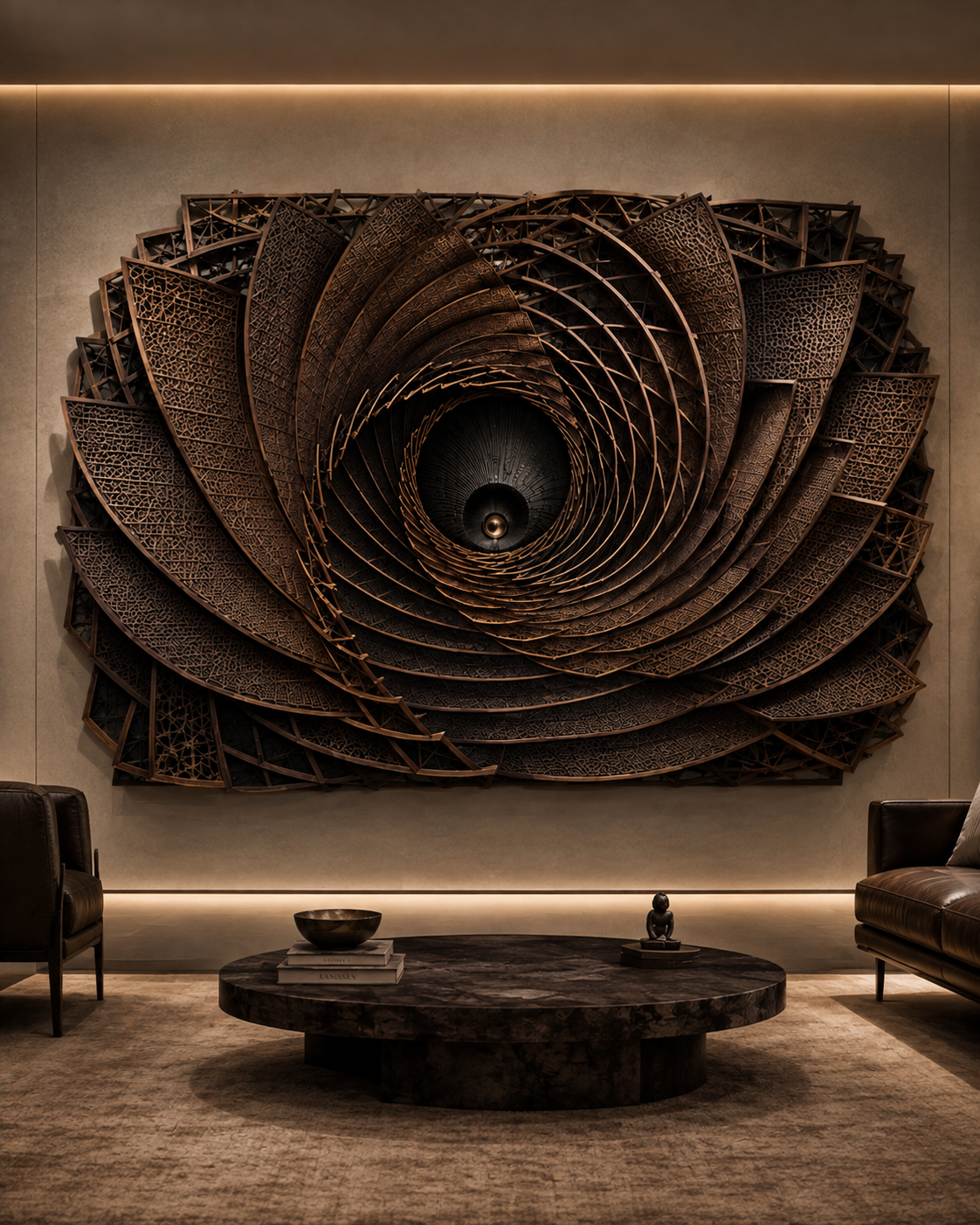
The Silence Engine in a media lounge
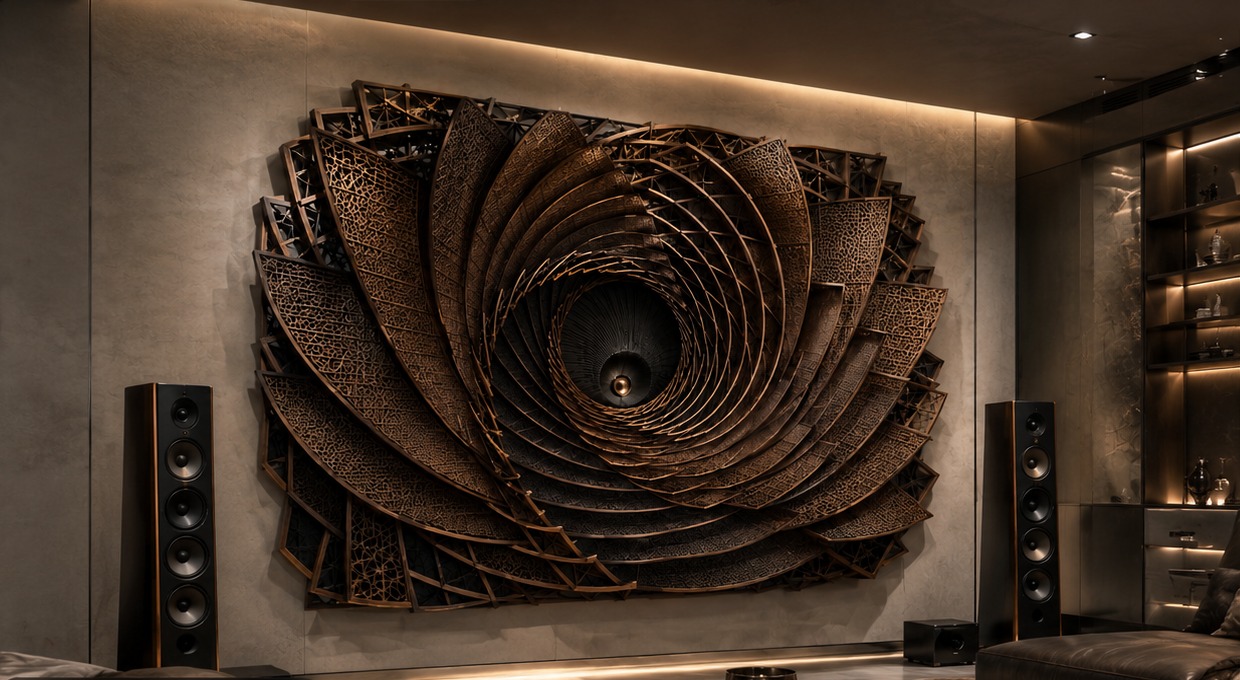
Illustrative visualisation at catalogue scale. Interiors, lighting and styling are shown to help read size and depth — not an installation template for your own wall.
Specification
- Dimensions
- 305 W × 180 H × 24 D cm; custom sizing available≈ 120 × 71 × 9 in
- Reference
- STH-SE-001
- Primary materials
- Carved walnut or teak fins; engineered acoustic core
- Secondary materials
- Concealed metal subframe; brass detailing; acoustic textile
- Finish
- Hand-oiled matte wood with optional antiqued-brass accents
- Made to order
- Yes
- Customisation
- Wood species, finish, vortex geometry, acoustic performance, dimensions and brass detailing
- Recommended placement
- Listening rooms, private lounges, home cinemas and large residential feature walls
- Installation
- Professional wall survey, concealed structural mounting and acoustic calibration required
- Shipping
- Custom crating; white-glove freight and installation quoted separately
- Care
- Dust with a soft dry brush; avoid moisture, solvents and direct HVAC discharge
Commission enquiry
This is a made-to-order commission. Price depends on scale, materials, finish and site engineering, and is quoted after a wall survey — there is no fixed list price and no checkout.
Sources
- Jali — Wikipedia — https://en.wikipedia.org/wiki/Jali
- History of Jalis in Indian Architecture — Penn State — https://sites.psu.edu/perforatedscreendesigner/history-of-jalis-in-indian-architecture/
- Jali in Mughal Architecture — DailyArt Magazine — https://www.dailyartmagazine.com/jali-in-mughal-architecture-the-most-delicate-stone-curtains/
- Kumiko — Japan Woodcraft Association — https://japanwoodcraftassociation.com/traditions/techniques/kumiko/
- Kumiko (woodworking) — Wikipedia — https://en.wikipedia.org/wiki/Kumiko_(woodworking)
- Understanding Diffusion — GIK Acoustics — https://www.gikacoustics.com/blogs/knowledge-base/understanding-diffusion
- Absorption vs. Diffusion — Illuminated Integration — https://illuminated-integration.com/blog/absorption-vs-diffusion/
- US Patent 9,508,334 (absorption-to-diffusion) — USPTO — https://image-ppubs.uspto.gov/dirsearch-public/print/downloadPdf/9508334